Parts that look alike
Two wheel bearings can differ by a single digit on the box. On a crowded rack they look the same, so the wrong one goes out and comes back the next day.
 Backed by NVIDIA Inception
A mechanic walks in and asks for a clutch plate for a Honda CD 70. You know it is in stock, because you bought a carton last month. But the helper who shelved it is on leave, and nobody else can say which rack it is on. The mechanic waits 2 minutes, then walks to the next shop.
ManageKaro is auto parts inventory management software for shops, wholesalers and distributors that sell parts. It is not built for repair workshops. It shows the stock at each shop and godown and records a rack and sub-rack for every part. The annual plan costs $36, and the 3-day free trial needs no credit card.
Pakistan had 39,297,497 registered motor vehicles in 2025, and 30,456,102 of them were two-wheel motorcycles, according to the Pakistan Economic Survey 2025-26. A parts shop has to stock for many of their models and years. If stock software is new to you, our guide on how inventory management software works covers the basics.
Two wheel bearings can differ by a single digit on the box. On a crowded rack they look the same, so the wrong one goes out and comes back the next day.
One brake shoe fits several 70cc motorcycles, and one oil filter fits more than one car. The same part also comes as genuine, aftermarket and local, each at its own price.
The counter holds a few pieces of each part, and the cartons sit in a godown. When a helper carries stock across without writing it down, neither count is right. Our post on inventory loss in small businesses lists other common causes.
Oil filters and brake shoes sell every day and finish without warning. Parts for a model that has left the market sit for years, and the cash you paid for them sits with them.
Workshops take parts all month and settle later. If each slip waits in a drawer until someone totals it, you learn the balance on the day you ask for payment.
This is what ManageKaro does as spare parts inventory management software. Every feature below comes with both paid plans and sits on the same inventory management software that other trades use.
You set up each shop, godown and branch as its own warehouse, with its own quantity for every part. Before you say yes to a mechanic, you can see whether the part is at the counter or in the godown. Our guide to multi-location inventory control goes deeper.
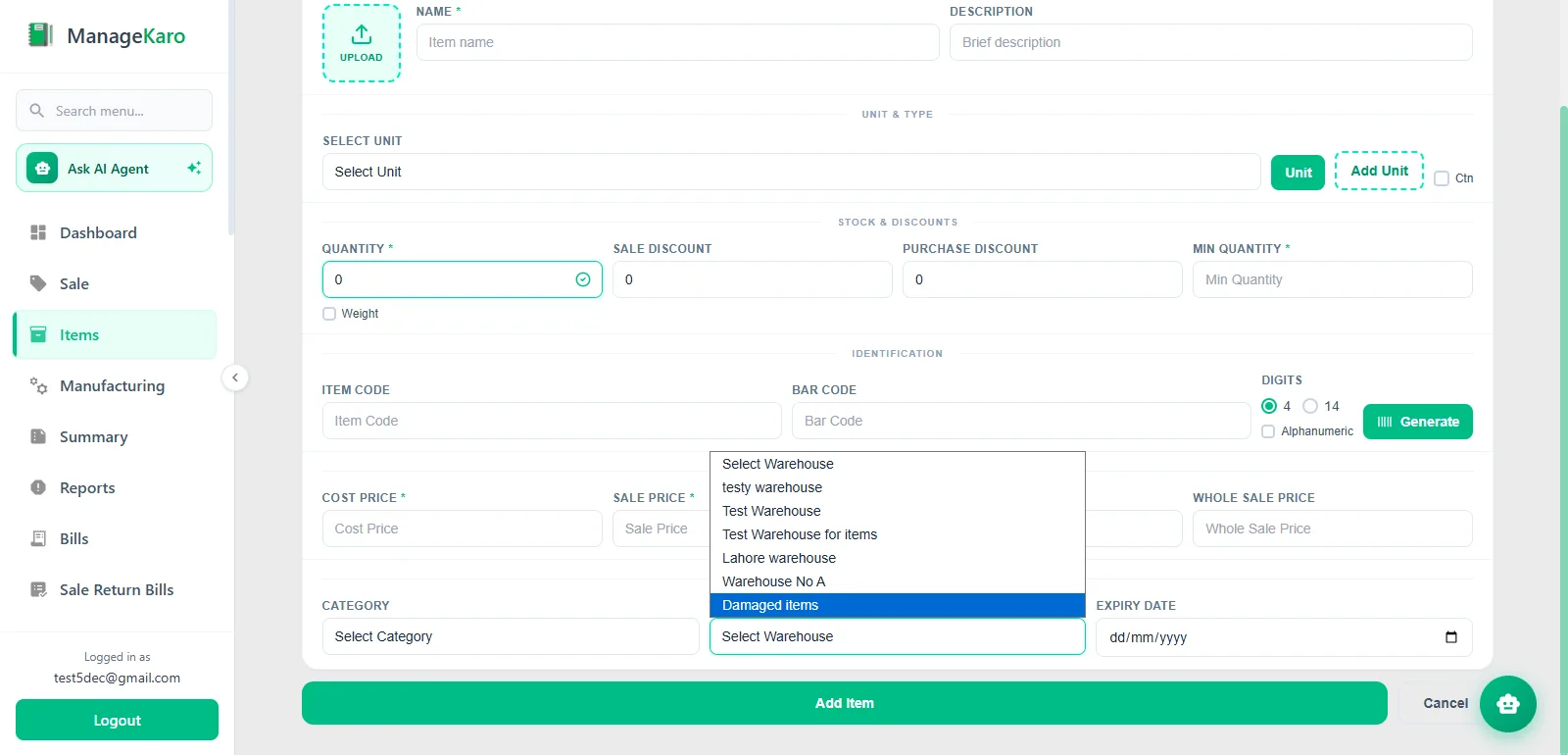
You can place each part on a rack and a sub-rack. Anyone at the counter can read the location off the screen and walk to it, even a helper on the first day.
When a part runs low, a low-stock alert tells you. You place the order while a few pieces are still on the rack.
Bill a part by barcode scan or product search in the POS and billing software. The sale reduces stock at the shop that made it. The invoice prints on a regular or thermal printer, or goes out on WhatsApp or by email.
When the counter runs short, record a transfer from the godown. It stays on record, so you can check a later count against it.
ManageKaro saves each purchase with the supplier and the date, and you can search by either. Our post on purchase management covers the buying side.
Every workshop and mechanic who buys on udhaar gets a ledger. A credit sale posts to it when you bill, and the ledger shows what the customer bought, paid and still owes. The daily book (roznamcha), the cash book and the profit and loss report are in the accounting software, which every plan includes.
When the internet drops, the desktop app carries on offline and syncs once the connection is back. Away from the shop, open the same account in a phone browser to check a part or a balance.
You can limit each staff login to one location, so the godown keeper sees only the godown. Attendance and salaries are handled in the HR and payroll module.
Here is one working day at a parts shop, in seven steps.
The morning delivery arrives from a supplier. You enter the purchase under that supplier's name and add the parts to the godown's stock.
The parts go on their racks, and you enter a rack and sub-rack for each one.
A mechanic asks for a part. You look it up, read its rack off the screen and bill it. Counter stock drops by the quantity sold.
A workshop takes parts on udhaar. The bill posts to the workshop's ledger.
The counter runs short of a fast-moving part. You record a transfer from the godown.
A customer in another city orders parts. The parcel leaves with a delivery challan, and you update its status when it is dispatched.
You close the day. The roznamcha and the cash book give the day's sales and cash in hand, and the low-stock alerts become tomorrow's order list.
Mechanics ask for a part by its number, by the vehicle or by the brand. Here is what is confirmed today. Each part has its own product record in the catalog, with a quantity at each shop and godown and a rack and sub-rack. At the counter, you find it by barcode scan or product search.
This page does not promise two things that matter to a parts shop. One is search by part number or OEM code. The other is a record of the models and years a part fits. Before you subscribe, ask our team to show both on 10 of your own parts.
Yasin Auto & Spare Parts on Kacha Ravi Road in Lahore runs its own online store. Mechanics from other areas order from it directly. The online store module gives a shop its own storefront with its own link.
Each parcel can leave with a delivery challan that lists the parts and quantities. The delivery management software marks every dispatch as pending, dispatched or completed, so you can answer a customer who calls about a parcel. If you send goods on your own vehicle, a gate pass records the driver's details. Our guide to delivery challan software shows what a challan should carry.
None of these habits needs software. Each one keeps the numbers on the screen true, and our post on common inventory mistakes covers more.
Give a part its rack before it goes on sale. A carton opened on the floor and sold from there never gets a location.
Enter genuine, aftermarket and local versions as separate parts. Each has its own price and stock, and one shared name hides which version is finished.
Refill the counter from the godown at a fixed time and record it as a transfer. Nobody writes down a trip made in the middle of a sale.
Sell the oldest stock first when a part ages on the rack, such as belts, wiper blades and engine oil. This method is called first in, first out.
Walk the slowest racks once a month. Return, discount or stop reordering parts for models that have left the road.
ManageKaro suits shops in Pakistan that sell parts for cars, motorcycles, rickshaws, trucks and tractors, at a retail counter or in bulk. A motorcycle spare parts shop with one counter uses the same features as a dealer with several branches. Parts wholesalers and distributors can also read the distribution inventory management software page. Shops that sell accessories as well can read the retail inventory management software page, and other trades are on the industries page.
These are not part of the standard product:
FBR's digital invoicing FAQs explain who must connect to its system and how. A business that is mainly a repair workshop needs workshop software with job cards, not parts inventory management software. If you sell parts and need one item on this list, ask our team before you subscribe.
Auto parts shop software in Pakistan is priced as a monthly fee, a yearly fee or a one-time payment. Some sellers add a setup charge. Before you pay for any spare parts shop software, put these questions to the seller.
| The question | Why it matters | The answer here |
|---|---|---|
| Can I see shop and godown stock separately? | The part may be in stock but not where you are standing. | Yes. Each location has its own quantity. |
| Can I record a rack for each part? | A part you cannot find is a sale you lose. | Yes, a rack and a sub-rack. |
| Can I search by part number or OEM code? | Mechanics often read the number off the old part. | Not confirmed here. Ask for a demo. |
| Does a counter sale reduce stock by itself? | A second entry is one more place for a mistake. | Yes, at the shop that made the sale. |
| Does a credit sale reach the workshop's ledger? | Udhaar needs a balance you can trust. | Yes, when you bill it. |
| Does it work when the internet is down? | A mechanic will not wait for the connection. | Yes. The desktop app works offline and syncs later. |
| What do I pay in the first year? | The yearly fee is not always the whole bill. | $36 a year or $89 once. |
A seller of inventory management software for auto parts should answer each one on a first call. Ask to see any vague answer on the screen.
ManageKaro has a free trial and two paid plans, and each one gives access to all features. You do not pay extra for billing, accounts or delivery.
| Plan | Price | What it includes |
|---|---|---|
| Free Plan | $0 for 3 days | All features, no credit card required |
| Annual Plan | $36 a year | All features, priority support, regular updates |
| Lifetime Access | $89 once | All features, priority support, all future updates, no recurring fees |
Current terms are on the pricing page. To compare this with other quotes, read our guide to what inventory software costs.
"In spare parts, keeping track of thousands of small items is the hardest job. ManageKaro's rack and sub-rack system fixed that; my staff now finds any part in seconds instead of searching the whole godown. We also launched our own online store, and mechanics from other areas order directly from there. Delivery challans and dispatch status are all tracked, so no more 'parcel kahan hai' calls. Our business on Kacha Ravi Road has really grown. Shukriya, ManageKaro team!"
 Yasin Auto & Spare PartsMain Kacha Ravi Rd, Karim Park, Lahore
Auto parts inventory management software is a program that records every part a shop holds and how many are at each shop and godown. It also records the rack where each part sits. The count changes when a part is sold, transferred or received, so you can check stock without opening a register.
A general shop sells products that customers pick by name or by sight. A parts shop holds thousands of small parts that look alike, and one part can fit several models. Stock by rack and by godown matters more as a result.
Yes. You can give each part a rack and a sub-rack inside a shop or godown. When someone asks for the part, your staff read the location off the screen and go to that rack.
At the counter, you can find a part by barcode scan or product search. Search by part number or OEM code is not confirmed on this page, and neither is matching a part to vehicle models. Ask the team to show both on your own parts.
Yes. The shop and the godown are separate locations, and each has its own quantity for every part. The auto parts inventory software treats a branch as one more location.
Yes. When you bill a part through the POS, the stock at that shop goes down by the quantity sold. You do not make a second entry in a stock register.
Yes. Each workshop and mechanic gets a ledger of their own. A part sold on udhaar is added to it at billing, and every payment is recorded against it. Check the balance before you hand over the next part.
Yes. The online store module gives your shop its own storefront with its own link, so a mechanic anywhere in Pakistan can order from it. Yasin Auto & Spare Parts in Lahore takes orders this way.
No. Job cards with technician and status tracking are not part of the standard product. A workshop that also runs a parts counter can use ManageKaro for the counter and should ask our team about the rest.
Yes. Billing continues in the desktop app when the connection drops, and the entries sync once it is back. For a parts shop in Pakistan, that covers an internet outage, as long as the computer has power.
You pay $36 a year on the Annual Plan or $89 once for Lifetime Access, and both come with all features and priority support. Before paying, you can use the Free Plan for 3 days without a credit card. Current terms are on the pricing page.
The free trial lasts 3 days, which is enough to test spare parts inventory management software if you plan it. Use your own parts, not sample data.
On day one, add your 30 fastest-moving parts and set up one shop and one godown. On day two, give each part a rack and a sub-rack. On day three, run one transfer, one credit sale and one delivery challan. Then count those 30 parts by hand and compare the racks with the screen.